Your Guide to the Great Migration
Roaming Rhythms
Exploring the Great Mara Serengeti Migration
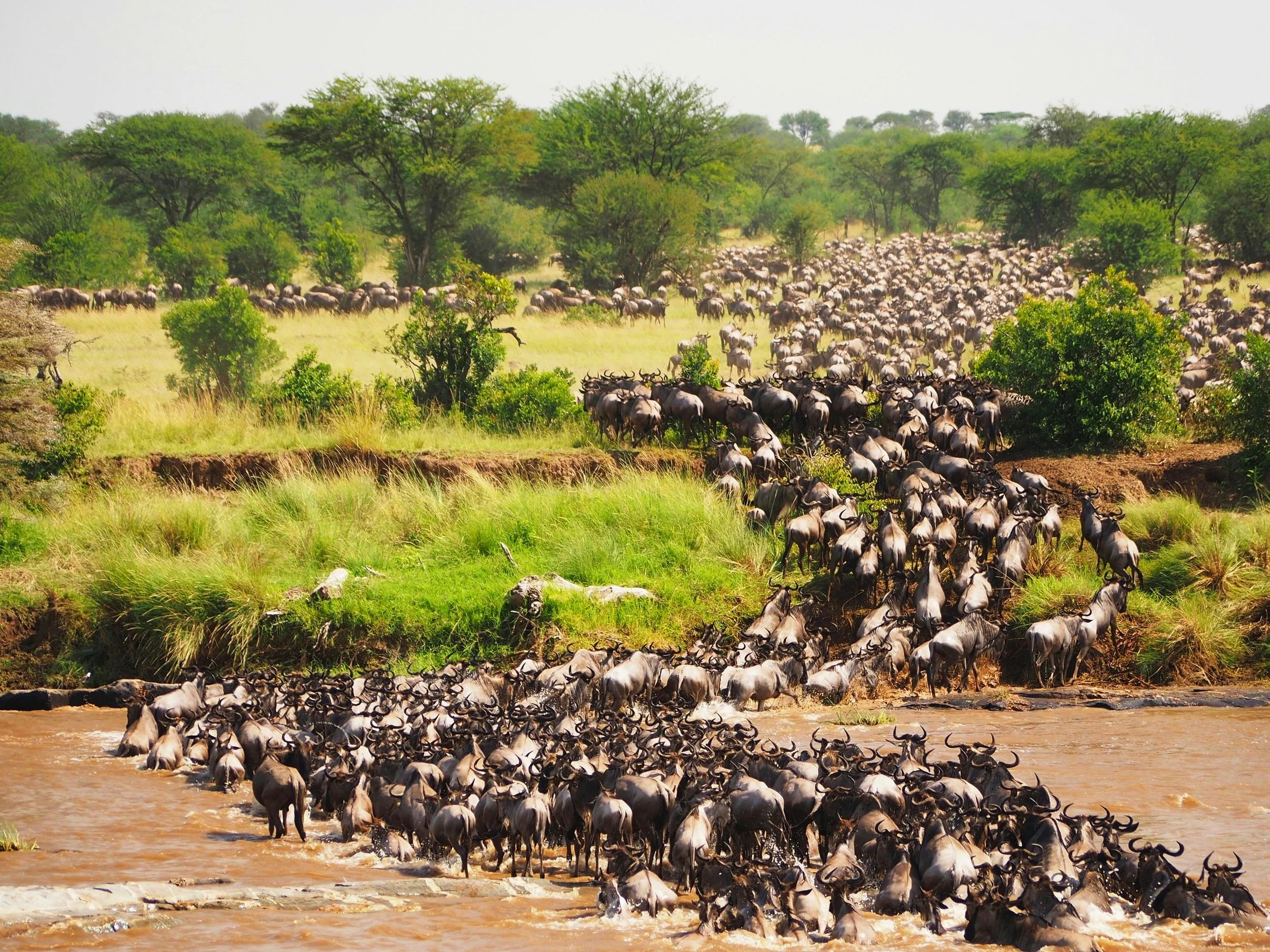
The Great Migration is a famous event loved by people who enjoy wildlife and nature. It's when more than a million animals keep moving in a loop between the Serengeti and the Mara. These animals, mostly wildebeests along with others, travel around looking for food and water. They start by having babies in the south of the Serengeti near Ngorongoro Conservancy. Then they go around the Serengeti to the Masai Mara in Kenya before going back again later in the year. Along the way, there's lots of excitement as predators hunt and new animals are born, making sure the cycle of life keeps going.

Unveiling nature's grand procession
With over 1.2 million wildebeests and 300,000 zebras in motion, the Great Migration is a testament to the resilience and dynamism of the natural world. From the Ngorongoro Conservation Area in Tanzania to the expansive plains of the Masai Mara in Kenya, the migration follows a circular path, guided by instinct and environmental cues. Along the way, predators lurk, rivers surge, and life teems in abundance, creating a symphony of movement and drama.

When does the great wildebeest migration start
Thousands of wildebeest herds resume their migration patterns roughly after March, soon after mating season and calving season have taken place. Remember, there are only major migration routes, not necessarily starting points. These are natural events and cannot be tracked perfectly. We give a month-to-month breakdown below.
-
Around this time of the year, the migratory herd completes its revolution, moving into the Ngorongoro Conservation Area from Serengeti’s short-grass plains. Because of the nutritious grass in Ndutu, the massive herds of wildebeest begin their calving season.
The newborn wildebeests are raised around grazing availability, and these months provide the best conditions. Nearly 500,000 new calves are born during this period, which marks a good beginning point for the migratory circuit to begin again.
While the herds raise their newborns, predators (such as lions, cheetahs, and hyenas) begin their hunt for food. Considering these months are a great time to witness the cycle of birth and death – the circle of life – in full spectrum.
-
Toward the end of March, the rainclouds move towards Serengeti National Park, so the herds move to new plains in search of fresh food and water.
On this route, in search of fresh grass, columns of wildebeest stretch along the migration path for several kilometers, making these magnificent beasts look like a moving ocean on the surface of African plains.
As May ends, mating season begins, followed by thunderous battles between male wildebeest. If you come during May, you will be the spectator of this massive movement alongside zebras, gazelle, and hungry crocodiles awaiting the Grumeti River herd.
-
June marks the beginning of the dry season in Tanzania. The wildebeest migration sends the herds marching alongside the southern banks of the Grumeti River, preparing themselves to cross deadly waters teeming with crocodiles.
As the end of June approaches, the herds move to the Northern reaches of Serengeti, slowly approaching the Mara River in Serengeti. The Mara River is the most dangerous crossing these beautiful beasts will undertake and perhaps the most humbling experience to witness on a safari.
The herds will face their most deadly challenge, with the river flowing and hungry crocodiles waiting patiently for their prey. The wildebeests overcome this massive challenge with what scientists call swarm intelligence: facing an obstacle as one enormous entity.
By July, the herds are found in Northern Serengeti, moving towards Masai Mara in Kenya.
-
As the thrilling chapter of the Great Wildebeest Migration Safari unfolds across the Serengeti Mara ecosystem and Masai Mara plains, the perilous Mara River crossing, a significant phase, nears its conclusion.
At this juncture, the crocodiles will have experienced their yearly feast, capitalizing on the influx of prey. With this challenging obstacle behind them, the massive herds will be shifting their journey eastward, marking the dynamic progression of this incredible wildlife spectacle.
Short rains begin in October and the migration of wildebeest marches on.
-
By this point, the wildebeest begins to circle back from Kenya and into Eastern Serengeti. The herds are stretched throughout the South and Eastern reaches when December falls.
Heavy rainfall rejuvenates the landscape as the new year draws near, carpeting it with lush green grass again. This signals the commencement of the annual wildebeest migration, a pivotal event in the great migration safari.
With the onset of the migration river crossings, the cycle of nature restarts, portraying a mesmerizing spectacle of movement and renewal in the wild.
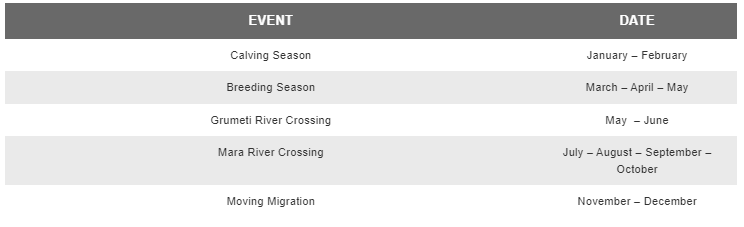
Annual migration pattern of wildebeest
Copyright @FreeHighQualityDocumentaries